*This is a crosspost from HackingEvolution.com.
This presidential race has been my #1 source of entertainment these days. Every person running just seems like, more than ever, a colorful character. Every debate stage seems to host a wild assortment of ideologies and issues, and it's been fascinating to see each candidate fall away one at a time, leaving the strongest to vie for the nomination.
Now that Rubio's out, it's down to Sanders, Clinton, Trump, and Cruz. Wow, just think about that.
Every single one of these people is vastly different down to a fundamental level. Trump and Sanders are outsiders, a reaction to the growing distrust of the government in an era of surveillance, industrial influence, and corporate pandering. Sanders emphasizes domestic social justice issues, while Trump emphasizes economic and geopolitical ones. Clinton is the only moderate left, the only one participating in the old and perceptively broken system that spawned support for Sanders and Trump. Although she's in bed with big money, her impressive resume seems to have made up for it. And then there's Cruz, an extreme religious conservative who recently spoke at a conference whose host (a pastor) called for the death of homosexuals.
This is the world we live in, folks.
There are at least a couple good reasons we see such an array of characters during this race: current political climate and changing consumption patterns in media. The current political climate is pretty straightforward, a response to Wall Street disgust and a dwindling middle class, a hopeless future for emerging generations (hence Trump's slogan "Make America Great Again," implying it's not great anymore).
Consumption patterns in media is what will connect this whole blog post to identity politics. When I worked in news advertising, it was very clear to me that journalism had an almost ancient, engrained sense of balance. It was really important for journalists to be fair, to look at both sides, to stick to facts. Part of this culture of journalism was necessitated by the nature of mass audience. If you take a side and there are millions of people reading, you're going to alienate and lose readers. And readers are what newspapers sell, because readers see ads.
But news is changing. We don't read papers anymore, we read social media. And perhaps, more importantly, we read online, where all of our tastes, preferences, and click patterns are meticulously tracked in order to produce personalized online experiences. If you notice a lot of anti-Trump videos popping up on your feed, you can be sure that Facebook is preferentially sending you that topic, and you can trust that somebody on the other end of the political spectrum has a feed full of anti-Sanders rhetoric, too. Because that's how we read news now, not news that's balanced, but news that's personal.
The great tragedy of this is extreme political polarization. Suddenly Trump is Hitler and Sanders is a Commie -- despite the obvious. The discourse is so extreme, there is no longer hope for fruitful debate. It is a worsening culture of identity politics.
Identity Politics is defined as the way in which various aspects of our identities influence our political persuasions, including things like race, class, religion, gender, gender identity, ethnicity, ideology, nation, sexual orientation, culture, information preference, history, musical or literary preference, medical conditions, educational background or specialization, professions or hobbies. It is relevant to our own identities and the identities of others.
Identity politics explains why Finance majors tend to think right, and Women's Studies majors tend to think left. Not always, but usually. And this is true for almost every aspect of one's identity. Over time, identity often snowballs. That Finance degree leads to a finance job; that Women's Studies degree leads to working in non-profit, where each identity is reinforced via social network and personal experience, etc. until each and every person is sure that they are right and therefore everyone else must be wrong.
It all comes back to evolution, because humans evolved a very strong sense of identity for themselves and others. We are built to quickly perceive duality (good vs evil), to form snap judgements, to label people or things. The question is how do we get out of this mode of thinking? How do we break our own biases in order to see what's true? Will we always have leaders so opposed to one another? Or worse, to have a populace that always mischaracterizes their own leaders? Perhaps somewhere in the fray is our political revolution, our political doom.

Wednesday, March 16, 2016


Thursday, June 19, 2014
The Book is Almost Here! Pre-Order Now on Kickstarter.

After five years of obsessively researching evolution and health, after three years of writing, revising, and pouring through academic literature, I have finally completed what I believe is the most important, far-reaching health book to date.
Big words, but I have the facts to back it.
- This is the first and only book to tie together countless health topics, far beyond the tired topics of diet, exercise, and sleep.
- This is the first and only book to fully integrate and emphasize the science of evolution, the cornerstone of every good idea about health.
- This is the first and only book to clearly lay out actionable "game theory" strategies for human well-being, all while pushing forward the scientific concepts within them.
This book traces the edge of human knowledge, where all good questions are asked. It completes an understanding of modern disease and human well-being, and you can now order it on Kickstarter! Check out the video:
Tuesday, April 8, 2014
Essential Gear for the Perfect Bro-Gym
***This is a cross-post from hackingevolution.com***
1. Olympic rings. Hang 'em high.

2. Hex bar is a more natural deadlift.

3. Thick rope for battling, climbing, and rows.

4. Fighter's ground-and-pound heavy bag.

5. High fidelity, wide range speakers. Because bass is a thing.

Thursday, February 28, 2013
This is Me Getting All 'Aristotelian' on Grains
 Aristotle was perhaps the first to popularize the notion that human beings are rational animals, that reason is simply a part of human nature. It is also commonly recognized that arguments must be structured according to reason; therefore, so should our personal decisions.
For those that are still on the fence about grains, or are having trouble seeing the Reason surrounding them, I've laid out all the reasons here for you, for and against.
Reasons to Eat Grains
- They have lots of fiber*
- They contain vitamins and minerals**
- They are inexpensive***
- They taste good****
*Though, it's insoluble fiber, which does not create habitat for healthy gut flora, may disturb a sensitive gut, and may even promote bad gut bacteria colonization.
**Once cooked, which is necessary in order to digest them, grains are among the least nutrient dense foods. And they are dramatically inferior to their carbohydrate alternatives in fruit, tubers, and starchy vegetables.
***Does not account for indirect health care costs, which, upon inclusion, may place grains among the most expensive foods along with sugar and vegetable oil.
****You're damn right they do.
Reasons to Not Eat Grains
- They might be toxic to you (gluten, gliadin peptides)*
- Grain production via annual monocropping is environmentally destructive and unsustainable**
- They are highly rewarding (opioids) and palatable (sugars), which fuels their overconsumption***
- They are nutrient-sparse compared to all other carbohydrate sources****
*Although up to 80% of the population may see inflammatory markers go up with the consumption of these proteins, classifying these things is difficult, arbitrary, and the lines have not been clearly defined in regard to who can and can't safely consume grains.
**Does not apply to traditional grain farming that promotes biodiversity, polycultures, etc.
***Palatability applies to anything that tastes good.
****Except for refined sugars and sweeteners, obviously.
Thursday, February 7, 2013
Three Glaring Red Flags in "Forks Over Knives"

***This is a cross post from HackingEvolution.com***
I've heard an awful lot about this movie from my friends, some of whom acquiesced to their deceptive endorsement of a "whole foods" diet, so I reluctantly gave it a watch. Since this vegan propaganda isn't worth much of my time, I'm gonna keep this short. Here are four red flags that should have you discounting everything this movie endorses -- except, of course, the importance of whole foods.
Red Flag #1: Fear Factor
Among all the things that motivate people, fear is largely regarded as the most potent. The entire beginning of this movie is a conflation of the fact that you are going to die. Soon. You will get heart disease. You will get cancer. And it's all because of your western diet: processed foods and industrialized meats.
Well, everyone agrees with that idea. But they don't need to instill the fear of God in me before presenting the facts, because that's overtly manipulative. A logically sound presentation will suffice. So from the very outset of this movie, we are already immersed in a world of emotion and sensationalism, then dragged through image of heart surgery after image of fat-attaching-to-our-arteries (an idea from the Eighties, by the way). That's a red flag.
Red Flag #2: False Designation
I'd guess that they said the phrase "whole foods, plant-based diet" about 100 times throughout the mindless drivel and half-truths that were this film. But guess what? This vegan diet is not composed entirely of whole foods, because grains are not whole foods -- even 'whole grains' are still highly processed. Their processing is necessary to make them edible. So, they're lying.
Also, double lie, because this is not a plant-based diet. This is a plant-dominated diet, consisting of 100% plants. The USDA food pyramid is plant-based. Hell, almost every diet is plant based. McDonald's menu is plant-based. It's clear they're using false buzzwords to further deceive us. That's another red flag.
Red Flag #3: Campbell Got Fired
The shady meat-loving secret police must have had it out for Campbell because he had the courage to tell the truth. That, or not that, are two possibilities.
One thing I love about scientists: they are very careful about what they say. You'll often see an abstract where their data overwhelming concludes something, yet they will still end up saying, "More research is needed in this area." It's nearly ubiquitous. I love that. It's humble and responsible.
Another thing. Scientists understand clearly that correlation is not causation. They understand that if you find a correlation, which is what Campbell did, you still need to take that idea to the lab and conduct real science: randomized controlled trials. Then, after you find something, and others confirm it, and a biological mechanism is revealed. Then and only then can you start running around, declaring that you have something to say.
Campbell went around spouting that all animal foods cause all the degenerative diseases, based almost entirely on correlations he found with the worst kind of data: government data. A scientist would never something like this because it drastically oversteps the boundaries of their evidence. Anyone with any level of statistical knowledge would not say this. I wonder why he got fired.
If you'd like more detail about the half-truths, check this out.
Wednesday, December 19, 2012
The Lifestyle of a Surfing Legend
*This is a crosspost from HackingEvolution.com* |
| "I think the key to happiness is maximizing each day. So if you're unhappy, here's a simple prescription: Live harder." -Laird Hamilton |
Laird Hamilton. Lance Armstrong. Micheal Jordan. See where I'm going with this? These men are sports icons. They have accomplished more than most men dream and have pushed the boundaries of sport in ways unimaginable. To many they are heroes and to all they are legends. But only one of them has a self-help book.
That book is Force of Nature, an examination of Laird Hamilton's success in surfing and in life. It breaks things down into four sections, Mind, Body, Soul, and Surfing, going into detail about his diet, training, social life, purpose, attitude, goal-setting, etc. in order to decode how and why Laird Hamilton became the surfing phenom that he is today.
And get this. He doesn't know it, but Laird Hamilton is living an ancestral lifestyle, one that is admirably close to nature in almost every way. In fact, Hamilton's lifestyle is an ideal example for all of us.
In the nutrition section, he praises organic, free-range beef as his number 1 favorite food. He explains that it's superior even to grass-fed beef, saying, "The closer to the wild, the better." He then goes on to sing the praises of raw seafood, seaweed, coconut oil, and raw butter from the milk of grass-fed cows. He extols the virtue of eating "real food from the earth" and warns readers to "beware of any 'food' that has been created by humans rather than nature." Sound familiar?
On a short list of the four foods he avoids, the first is bread, the second is pizza, and the third is soda. (The fourth on the list was cheese, but then he includes it later in grocery lists and dishes and admits that he prefers raw cheese...I'm not sure why he included it here with the others. This list should have been the 3 foods he avoids, given how he and the publisher/editor looked rather favorably on the right kinds of cheeses.)
Hamilton's training routine focuses on functional fitness. He writes, "It's not how much weight you can lift, it's how much strength you can incorporate into your movements. You want strength that you can actually control and apply." He also advocates changing up your routine and working on balance. These ideas are central to the programming you see in the world of ancestral health, where movements are based on natural patterns and skill-building.
Hamilton is also big on going barefoot:
"As many runners are discovering, shoes can actually decondition feet. That weakness leads to decreased performance and increased injury, which is why many athletes are now incorporating barefoot training into their workouts.
I go barefoot whenever I can. When I surf, I'm using every last muscle, ligament, and tendon down there. There's a matrix of tiny muscles between the sole and ankle that most people aren't even aware of. I need them. I need my feet and toes to be able to dig in; to be sensitive, flexible, strong, and resilient. I don't need them to be trussed up and immobile--ever...Anyone who's ever walked barefoot through warm sand or cool grass knows that feeling the earth through your soles is one of life's great joys."The book also slights mainstream advice. In a brief cameo by trainer and educator Paul Chek of the Corrective Holistic Exercise Kinesiology Institute, Chek writes, "I'm constantly amazed -- perplexed, actually -- at how all these people with master's degrees and PhDs in health and medicine can't even keep themselves healthy. They don't eat right, and they don't know how to take care of themselves. Some of the sickest people in the world are at nutrition conferences. Blows my mind." While knowing health and practicing health are two separate things for many health professionals due to the demands of their education and careers, I certainly agree that conventional health authorities may not be the ideal place for people seeking to optimize their health. The purpose of medicine, after all, is to make sick people better. And the purpose of nutrition is to reasonably sustain the Average Joe. Neither of these seek optimization.
This book is good for its simple, fad-free accessibility, built only on the popular brand of Laird Hamilton himself. It's something that anyone can pick up and respect. And the fact that it's so in line with an evolutionary perspective, without ever saying so, means winning my endorsement. Hamilton is a strong example of the ancestral lifestyle, so immersed in nature, that he makes me feel like a slacker.
While the book has some minor problems, I would recommend it to anyone for the quality advice and the cogent way it captures all the elements of health and well-being within an overall lifestyle. Here, it's presented as a surfing lifestyle -- but I like to see it as one very close to nature. In evolutionary terms.
"I may be an extreme case, but we all need to take risks. I think it goes back to our primitive state, our deepest DNA, when we were hunters and had to avoid getting eaten by large animals. Survival meant risk. The thirst for adventure is part of human nature. It's in every cell of our bodies."- Laird Hamilton
Friday, October 12, 2012
Drawbacks to Paleo Diet Branding
Having spent years in marketing and advertising, I've come to identify a drawback in the way that people perceive, and are introduced to, the Paleo Diet and its derivatives. It's something that unfortunately detracts from its worth, because it distracts from its grounding in the truth and science of human evolution.
It starts with the way the human mind is structured. Humans do really well with identity; that is, we can easily and efficiently attach an identity to an idea, regardless of whether that idea is animate. I'm talking about brands, which permeate the business world but also leak outside of it. Brands are useful precisely because they take advantage of the natural way that humans perceive identity. For commercial purposes, 'Diets' are introduced as brands because this method is the most easily digested by the market, and therefore the most economically viable. Think about The Atkins Diet, The Cabbage Soup Diet, The Juice Diet, The Hollywood Diet, The South Beach Diet -- and holy shit -- The Paleo Diet.
This is part of the reason that the Paleo Diet is belittled and trumped by the caveman mystique. It's much easier for people to latch onto 'eat like your caveman ancestors with the Paleo diet' than 'discover the appropriate species-specific diet for the human animal'. Likewise, if you wrote a book titled An Analysis of Appropriate Human Foods Informed by Evolution, it would be a publisher's nightmare because there is no brand, no meme, no idea to make the book's information easily consumable or identifiable. This has positioned the Paleo Diet between a rock and a hard place, because the brand identity itself is ultimately what limits the power of its message.
Thursday, January 26, 2012
An Etymological Defense of 'Paleo'
'Paleo' has become a word. That much everyone can agree on.
It all went awry when it became a brand-philosophy. Suddenly, you had 'Ancestral'(?) thought leaders drawing arbitrary lines in the sands of progress. The movement that I had come to recognize as a loosely cohesive, diverse, and burgeoning discipline that was going to shed light on the true nature of our species and do the hard work of interpreting possible or even optimal manifestations of that truth, suddenly became a colleague-bashing, factional display of ego. There were all these people who wanted to interpret evolution in healthy debate about health -- yes, this is important -- but not wanting to participate in a cult brand or pseudo-philosophy.
So some of them disparage the word, avoid the word altogether, or even smite the logic of the word, all without offering a linguistic alternative. I'm not really here to judge the way that unfolded. I'm here to defend the simple use of the term 'paleo'. Not the brand, just the useful manipulation of an element of language.
Whether paleo-ancestral-primal-archevore-evolutionary-etc., the word 'paleo' has become a part of my vocabulary, and it will stay that way for one reason: it's useful.
When I look at my girlfriend and ask, "Is this paleo?" She knows exactly what I mean. I don't need to go into the intricacies of ratios and toxins and cooking methods and packaging. She knows exactly what I mean, and it has little to do with Cordain's Paleo Diet.
When I ask, "Is this paleo?" what I mean is, "Is this food natural to the human diet in evolutionary terms and healthful according to the general standards of ancestral health experts?"
There really is no other word that can accomplish that. It is a word rife with meaning and subtlety and complexity -- dare I say beauty -- and cannot be replaced. It has become the cutting edge of health language. The words before it, words like "organic" and "whole" and "natural" have been rendered obsolete in my eyes, because they have been captured in a word's simple evolutionary perspective. Phrases like 'all-natural feedlot beef' and 'organic whole wheat pasta' are an ancient useless language.
'Paleo' is a word that emerged from the ashes of ideological fragmentation, stronger and more comprehensive than before, and should be regarded as such.
Wednesday, January 18, 2012
Overcoming Nature Part II: Attraction and Marriage

Let's think primitively about the initial stages of love (and some of the mechanisms of attraction):
Step 1: Woman makes herself attractive (tight clothes, short skirts, make up, cleavage).
Step 2: Man is attracted, chases woman, makes himself attractive (dates, confidence, humor, pheromones(?)).
If attraction is developed by both parties in the initial stages of a relationship, much deeper and significant things happen. They discover common interests and passions. They develop trust and companionship. They find intimacy and love. You know, it gets all Disney and shit. (Well, not for long, some will argue.)
My beef with modern culture -- and one of the ways in which modern culture does not differ from the natural model -- is that we still play this simple game. I'm not saying that this 'game' is necessarily bad -- I'm just saying that this game can be played better.
Some degree of minimal attraction is necessary in order to tumble down the rabbit hole of love, but not much. We can be more strategic about the things we value in others from those initial points of attraction. Shouldn't men be chasing women with traits that are 'good' but outside the realm of biological attraction? Shouldn't women? Maybe it already is.
Also, the model itself can be -- and is -- manipulated at its most basic (e.g. man makes himself attractive, woman chases man). At some point, there must be attraction and an agent, someone who makes moves.
'Playing' this game all depends on individual goals. Men wanting sex will play a different strategy than men wanting marriage, for instance. And women wanting sex will...get it no matter the strategy it seems.
What has been called the 'cult of monogamy' is certainly at odds with human nature. We seem to be good at attracting and reproducing, bad at sticking it out 'til death (marriage). To some degree, there is a sense of duty and obligation to lover, family, community, and/or society that may transcend the natural compulsions of others or even some in the 'cult of monogamy' beyond religious indoctrination; that is, 'I owe it to society to stick this boring marriage out and raise this family in a stable household'. So then, why not? Why not choose the path to societal stability?
Boredom, for one. If the meaning of life is a healthy society, I might yawn while sort of agreeing. But can't that just be one goal among many? Is it even possible to balance the natural compulsions of the human animal with the communal obligation of the human being? Maybe we have already.
The modern 'cult of serial monogamy plus paramour' seems to match the ancient 'evolutionary model' to a surprising degree. Can it be that, for many, our natural compulsions are simply too strong to withstand? Has society evolved its norms and conventions in the direction of nature, all thanks to feminism?
I'll let you answer that.
Thursday, December 22, 2011
Overcoming Nature Part 1: the Alpha Male

Sometimes I wonder how individuals draw the line in their evolutionary lifestyle, and I realize that within the philosophy there are all kinds of different conclusions about how to live wild in the modern world. Some climb trees, some still hit the gym. Some eat potatoes, some don't eat tomatoes. Some run marathons, and some do marathon wine drinking. It's a rich and varied world out there, folks.
Others have emphasized the silliness of historical re-enactment, but it's worth reiterating, because I wanna take the idea one step further, to culture. Much of the talk about what's good or bad about the paleolithic model tends to center around diet and exercise, but there are some profound ways that we are, well, being douchebags to each other. And yes, it's bad to be a douchebag. In smart people terms, there are identifiable natural mechanisms at work that detract from human potential and general human goodness. I think it's worth calling them out and playing them down.
Status Seeking
We are hard-wired for thinking about nearly everything hierarchically. Paleoanthropology touts the 'alpha male' model, where male hierarchy is formed by "a mixture of strength, hunting skills, and force of personality" (Bond 203), which leads to the alpha male designation.
In short, we want on a biological level to feel smart, strong, influential, and successful. But since everything is relative, this really just means that we want to be better than others around us. We want a better house, a more beautiful wife, a nicer car; in all, better status relative to others and especially to our own social network. These natural compulsions translate into careerism, wealth accumulation, selfishness, and so on -- all of which are 'totally natural' in evolutionary bro-wisdom.
So why's that bad? It may not be. There may be people out there being true to themselves by stepping on toes and that's all good. But there's a lot of unhappy people out there chasing goals they barely understand without ever questioning why they want those things to begin with, or whether the world and they themselves would be better off without those goals.
Introducing: The Douchebag Alpha
Ever meet a guy with an alpha male complex? I'm sure you have. He's the guy that gives orders like he's the boss, interrupts you while talking, rarely smiles, has to beat you at everything, doesn't share with others. You know the type. If you're a woman, you might 'naturally' be attracted to his confidence and social standing (more on this to come in the next blog post). If you're a man, you might respect him in that I'm-not-sure-I-like-or-fear-this-guy kind of way. But if you're astute to the ridiculous game he is playing, then you know the truth -- that objectively, this person is a douchebag.
I know where this discussion is headed. "But hey, it's only natural for a group of people to need to follow someone who can unify the group and take decisive action." Yes, but that's called leadership. Perhaps there may be a fine line between a leader and an alpha-douche. I mean to point out the difference between the two.
5 Things I Hate About Alpha Males
That fratitude. After coming of age, it shouldn't take long to figure out what is cool, and what is uncool. Or what life is about. So stop giving me your I-Am-Hunter face and be real for a second.
False leadership. A circle of friends is no place for a one-man cheerocracy. Take the thoughts, feelings, and ideas of others into account before acting like you run the show.
The motives. The respect? The status? All the girls? Grow the f*ck up.
It's obvious. I bet some men think they are sooo clever playing 'cocky-funny' to girls and sticking their chest out.
It's annoying. In fact, being alpha is bad for everyone, including the alpha. And check this out too.
Thoughts?
Thursday, April 28, 2011
The Brain That Changes Itself

The Brain That Changes Itself is a book that contains some powerful intersections between neuroscience and the paleo lifestyle. It's by Norman Doidge, M.D., who researches at Columbia, and wrote a fascinating account of the frontiers of brain science. Some truly remarkable stuff.
The book mainly explores neuroplasticity, the idea that the brain can be changed on a neuronal level through environmental changes in stimuli. I wanted to share a couple of quotes from the book that I think my paleo people will enjoy.
In support of novel, dynamic, complex movement:
"That's why learning a new language in old age is so good for improving and maintaining the memory generally. Because it requires intense focus, studying a new language turns on the control system for plasticity and keeps it in good shape for laying down sharp memories of all kinds...Anything that requires highly focused attention will help that system--learning new physical activities that require concentration, solving challenging puzzles, or making a career change that requires that you master new skills and material...The same applies to mobility. Just doing the dances you learned years ago won't help you brain's motor cortex stay in shape. To keep the mind alive requires learning something truly new with intense focus. That is what will allow you to both lay down new memories and have a system that can easily access and preserve the older ones." (pp. 87-88)
In the world of exercise, variation is universally recognized as a good thing, but I bet most people don't truly run with the idea. When I first got into weight training as a young man, variation meant bench press one day, incline bench another day. But there is far more potential for variation in movement, and it just requires a bit of imagination. I like to think of exercise as a skill building endeavor. That way, you get the benefits of focus and learning.
I'd suggest marrying what's fun with what's challenging. So forget zumba, it's too easy, and take up salsa. Skip the weight room now and again, and throw some sand bags around. Even carpentry or gardening fit the bill.
In support of barefooting:
"Finally, they are working on 'gross motor control,' a function that declines as we age, leading to loss of balance, the tendency to fall, and difficulties with mobility. Aside from the failure of vestibular processing, this decline is caused by the decrease in sensory feedback from our feet. According to Merzenich, shoes, worn for decades, limit the sensory feedback from our feet to our brain. If we went barefoot, our brains would receive many different kinds of input as we went over uneven surfaces. Shoes are a relatively flat platform that spreads out the stimuli, and the surfaces we walk on are increasingly artificial and perfectly flat. This leads us to dedifferentiate the maps for the soles of our feet and limit how touch guides our foot control. Then we may start to use canes, walkers, or crutches or rely on other senses to steady ourselves. By resorting to these compensations instead of exercising our failing brain systems, we hasten their decline. " (pp. 90-91)
Especially in regard to aging, these ideas matter greatly. I think the takeaway here is the fundamental connection between motor processing and movement in the physical world and all that it entails (sensation, balance, etc.). Movement is a complicated mechanistic dance between many variables in the brain and body, and you can enhance those mechanisms simply by kicking off your shoes and applying yourself to something new. The results, however, are more universal and even surprising improvements and changes in brain function.
Friday, April 22, 2011
The Detriment of Sentiment

Let's get deep for a moment.
Out of stardust, life sprang, and our planet developed into dynamic, beautiful, interconnected ecologies. From stardust arose consciousness, emotion, the things that make life precious. That blows my mind, and is the underlying framework for why I love animals so.
I spent last weekend touring some of the farm country of Carolina, meeting the farmers who articulated more like scientists, but most notably, meeting the healthy, lovable animals that I had been eating. I met them face to face, and I wallowed in how cute the pigs were piled together comfortably in the dirt, and I saw beauty in the subtle colorations of turkey feathers, and I melted when I pet the soft coat of the baby goats, and I lingered near the chicken coop to hear the young chicks chirp out their song.
In those warm moments, never before had I been so sure that killing and eating animals was the right, just, and responsible thing to do. Because none of those animals would be there if I didn't.
At one farm, they were barbecuing lamb sausage near the pen where the live sheep were held. The irony was deafening, and even uncomfortable, to look out at the cuddly creatures while enjoying a lamb sausage. A child among us was quite vocal about her discomfort, and a couple in our party chose not to partake in the "World's Best Lamb." Understandably so.
We are not immune to sentiment. Killing is a brutal thing no matter the method. But feelings betray us.
We live on a planet where lifeforms must kill and consume other lifeforms in order to survive. This is the dark, beautiful, universal truth of the world. Whether grains from an unsustainable factory farm or animals from a real farm, we must kill and consume other lifeforms.
On the real farm, those animals were born to be eaten. To not eat them is to abort them, and to eat them is to give them the gift of life. It's a mutually beneficial ecological relationship.
I watched those pigs relish rolling in the dirt. They would stick their snout in the feeder and make that cough-sneeze sound and then waddle to the shade and collapse there. I saw the dogs run playfully through the rows of vegetables, yapping at the other animals. The ducklings circled each other in a dark puddle, keeping their brothers and sisters near. Their mother had black speckles evenly spaced throughout her rich brown feathers. The father wore a white necklace and a turquoise sheen glowed from under his black chest. They were family.
Tragic to think they would have never been born at all.
Friday, April 1, 2011
China Study II: Income and Disease
In this culminating work that pools the same national data as the original The China Study, T. Colin Campbell applies a sophisticated form of meta-analysis to reach some startling conclusions about how our wealth affects our health.
Here's my favorite page, right out of The China Study II. Notice the strong correlation below?

The China Study II: Income and Disease is rife with correlation after correlation like the one above. Since correlation indicates causation, the conclusion is clear: money causes cancer, and is probably responsible for the sweeping array of debilitating diseases of the wealthy, from chlamydia to hairy tongue.
The data has spoken. I urge you to give up your wealth in order to achieve better health. Send your money to poor countries like Ceylon and El Salvador, so they can be the ones with face cancer. It's only fair that they share the burden of wealth with us, for we are all equal children of God.
Happy April fools,
Kev
Tuesday, March 29, 2011
More Vegetables Than Vegetarians
The media has done a superb job of branding the paleo diet as a meat diet. Indeed, people seem to think that's all we eat. Many naysayers go there first, naming The China Study or maybe even some other idiot who skipped Day 1 of Stats class (when they teach the refrain, "correlation is not causation"). Or worse, they cite conventional wisdom as a legitimate source, "But all doctors say the same thing about meat."
Conventional wisdom holds little weight with me, but if that's what will convince some people (perhaps the ones who skipped stats AND history class), then let's roll with it. (History class, by the way, is where you learn that conventional wisdom is ALWAYS wrong.)
Perhaps the most universally accepted piece of conventional wisdom about health, told by our grandmothers and our cartoons and our doctors and our vegetarians alike, is "eat your vegetables." Well, I'm here today to demonstrate that the paleo diet is more vegetably than a vegetarian diet. Now please allow me to unravel your cognitive dissonance with copious amounts of what is known in academic circles as 'quantifiable proof'.
Following are 4 randomly selected vegetarian food pyramids from the interwebs that espouse vegetarian diets. To account for paleo bias, I chose three that were vegan.

Vegetarian Example 1: Vegetables come in at about 15-20% of total food volume. The biggest group? You guessed it! Grains.


Vegetarian Example 2: Vegetables come in at about 15% as well, being stamped out big time by grains that dominate almost 30% of the pyramid.

Vegetarian Example 3: Same story with vegetables again at 15%, being drowned out by Neolithic foods like grains, dairy, beans, even sweets.
Vegetarian Example 4: Vegetables come out of nowhere with 30-35%! Don't know why tomato is in the carb section, but I'll let that slide.
Vegetarians average (an inflated) 20% vegetable intake on the pyramid. Not too shabby.
Now, for some mind-blowing. Four Paleo Pyramids:

Paleo Example 1: Boom. Primal Blueprint puts vegetables in the base of the pyramid, I'd say that's about 20-25%.
Paleo Example 2: Some random loser posted this I bet. Veggies at 15%. (Outlier, obviously. But we'll count it.)

Paleo Example 3: CastleGrok's pyramid gets chosen at random and delivers vegetables at a whopping 25-30%.


But wait. Paleo Example 4 (perhaps closer to average than any other) delivers vegetables at about 30% yet again.
Paleo wins with about 25% vegetables in the diet. But I'm not satisfied.
I know for a fact that I eat almost twice the vegetable matter than my veggie-minded friends and especially more than my conventional-eating cronies. And I think that deserves some exploration.
First, let's look at the economic incentives. Vegetarians are likely to eat disproportionately more grains and legumes than the pyramid recommends because those things are cheap; Paleo dieters are likely to eat disproportionately less meat/fish because those things are expensive (we buy fresh, wild, grass-fed to boot).
Another confounding variable is population. Vegetarianism attracts people for two reasons: ethics and/or health. In particular, people sympathetic to animal rights and sold on disease prevention. These populations are not concerned with measuring proportions or optimizing athletic performance and are therefore more likely to stray from the 'optimal model' or pyramid, quite reasonably leading to indulgences, not to more vegetables.
The paleo population is also dominated by people concerned with ethics and/or health. In particular, environmental responsibility and athletic performance. Because they are motivated to excel athletically, they are likely to adhere to the optimal model, which limits fruit and nut intake, inevitably leading to even more vegetables than their vegetarian counterparts who stray.
Also worth noting is that vegetarianism in general contains more categories of food, commonly dairy, grains, legumes, sweets, fruit, etc. The more categories, the more each category becomes diluted. And you bet your ass that the vegetable category dwindles with all the others.
Now, excuse me while I go eat meat.
Monday, March 21, 2011
Undeniably Sustainable Animal Foods
I'm so sick of hearing the oversimplified argument that 'meat is bad for the environment'. Here are three whole categories of food that either promote ecological health or have a neutral effect. (Be sure to account for the benefit of excluding unsustainable grain production.)
1. Regenerative organic husbandry, like pastured beef (read this Guardian piece)
2. Overpopulated species, like deer and rabbit (read this post)
3. Alternative protein, like insects (watch this TED talk)
Further reading:
Meat: A Benign Extravagance, Simon Fairlie
The Vegetarian Myth, Lierre Keith
Tuesday, March 15, 2011
Take the 2011 Paleo Community Survey
In order to understand the nature of the paleo movement and possibly win some swag, I urge you to take a few minutes with the 2011 Paleo Community Survey. From the Naturally Engineered landing page:
Why should you participate?
The resulting data will be invaluable in terms of understanding the nature of the paleo movement. It will be provided to other bloggers and researchers with the goal of providing a clearer picture of how the paleo diet has affected the lives of its adherents. The survey itself is relatively short and should only take a couple of minutes to complete.
As well, several incentives for completion of the survey have been provided, and will be explained further at the end of the survey. These include a coupon code for Paleo Treats products and the opportunity to win one of several giveaway Amazon.com gift cards.
Thursday, February 24, 2011
Qualitative Results on Self-experimentation

So what's up with self-experimentation? Is it dumb or helpful?
I think Kurt Harris was right when he played down the importance of results on self-experimentation, but I also think Richard Nikoley was right when he pointed out that personal results aren't always in line with mainstream expert opinion.
Solid scientific evidence is king, especially when it cautions a certain food item, but where the grey area exists, self-experimentation can be helpful. This is why several weeks ago, I embarked on my own self-experimentation. By no means was this extensive. I just wanted to see how my body reacted to changes in diet, in order to see if the diet could be optimized for my own goals.
The particulars: I gave about two weeks to each type of eating strategy, keeping to it about 80-90% of the time. Some of the categories may seem strange, but they were things that I either came across or dreamt up or heard interesting arguments for and wanted to try them myself. I only noted things that were significant, so no 'this kind of, sort of changed'.
I should note that I was doing more of a pure paleo diet before starting this experiment. That means Cordain-style. No proportions or anything, just eating the right foods whenever I wanted, as much as I wanted, and not worrying about anything. Also, I exercise 3 to 6 days a week, highly varied in different elements of athleticism: aerobic, strength, etc.
Here are some observations of each of my adventures:
Pure paleo. Low fat, low carb, meat, veggies, fruit, nuts, berries.
*High variety in food items eaten
*Great skin tone
*Lean physique (certainly not WeakLean)
*Tremendous appetite
*Sometimes limited mental focus and burnout
*Consistent, sustained energy levels
*Dodgy appetite (always somewhere between hungry and full)
*Improved recovery time
*Blunted binge 'cheat' cravings (cuz I was never starving for them)
*Gains in speed and strength over two weeks
High-carb paleo. Added potatoes and white rice, moderate fat intake, 3 meals a day.
*Energy fluctuated throughout the day
*Digestion issues
*Meals were filling and cheap
*Slight fat gain
*Plenty of energy for exercise
*Increased appetite
Lacto-paleo. Added butter and cheese mostly, little milk and greek yogurt.
*Skin tone went to shit
*More dynamic flavors in meals
*Digestion just fine (unexpected result)
*Low food volume (felt full on less)
*Decreased appetite (butter)
In conclusion, I learned a little and found some gems outside the Cordain-paleo model. I'm certainly going to use more butter, simply because it's palatable magic. Also going to add potatoes every now and again. Red potatoes in particular are delicious.
There's also the fat issue. I found that consciously adding fat to meals was very helpful, and made the meal taste better and quench my appetite more easily. This was true for butter, as well as paleo stuff like avocado, coconut, even olives. It was also helpful to think of each macronutrient relative to others, and I'm still doing that without even trying because it makes cooking easier.
I found that the Zone diet was too frequent of meal timing to be convenient, and I'm the kind of guy that likes to gorge himself, so I'm sticking to three meals and some intermittent fasting. I'm definitely not drinking milk, and I'm leaving cheese for cheat meals because I want my skin complexion back. Also, I found white rice to detract from the flavor of the meal most of the time, and it did weird things with my digestion, so I'm limiting that too.
N=1 might be bad science, but it helped me tweak my diet so that it's more fun and more substantive. I can definitely vouch for self-experimentation.
Saturday, January 22, 2011
Quick Book Review: The Jungle Effect
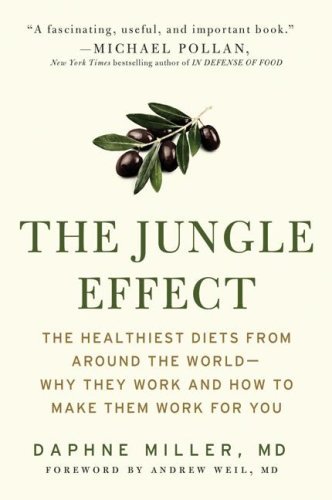
Just finished thumbing through The Jungle Effect, an anthropological look at some of the healthier people on Earth and what their unique diets might tell us about disease prevention. It sticks to exotic cultures, like the Tarahumara in Mexico, the Okinawans in Japan, the Cretans in the Mediterranean, and so on. Daphne Miller, the MD-turned-anthrocurious-traveler who authored The Jungle Effect, practices medicine in San Francisco and teaches nutrition at UCSF, so that's how come you're supposed to listen to her. But as you may know, the medical establishment often vies with the evolutionary-proned biases you see here on this blog. So, yeah.
The book adheres loosely to the slow-carb diet, where non-paleo foods are encouraged based on the fact that these exotic cultures eat lots of them and seem to be just fine. "Just fine" meaning that they don't have diseases. I certainly wouldn't say she is seeking health optimization, like so many of us do here in the paleo community. (The book oddly reminds me of Weston A. Price, who concluded that raw milk was good for you based on reasons similar to Daphne Miller's.)
It was fun to read about the Tarahumara, because I finished Born to Run yesterday, which is all about running and the Tarahumara take center stage in that book. (Born to Run yesterday, The Jungle Effect today -- it's like I'm an English major again!)
The Tarahumara are examined in the realm of Type 2 Diabetes. They eat a diet of primarily maize (corn) and beans, and they run hundreds of miles at a time. She concludes that a similar slow-carb diet could be equally beneficial for Westerners with Diabetes since the Tarahumara don't get the disease. That means 70% of total calories from carbohydrate sources. On the plus side, she acknowledges that their use of lard as a good choice for cooking, though only in tiny amounts.
So why am I even reviewing this book when I don't usually review books?
While I respect her anthropological perspective on health and her honorable background in medicine at a fine institution, I was bothered by a few things worth highlighting for you, esteemed reader.
Obscure line of reasoning. The Tarahumara don't have diabetes, so mimic their corn and bean diet? Sounds especially strange from an MD. Although, her true recommendation only leans that way moderately.
Overemphasis on diet. While she did a great job examining the anthropology of diet, I would have liked a great deal more information on the other major factors of health: sleep, stress, posture, movement, community, toxin exposure, etc.
Maybe it goes to show that part of why anthropological evidence can be so frustrating is because it's so inconsistent. You get people eating mostly carbs that have minimal disease (Tarahumara), then people eating mostly fat that have minimal disease (Eskimo). Therefore, it's hard to take one example conclusively, especially when there are equally viable ones elsewhere ready to rebut.
Tuesday, January 18, 2011
Eat Ice Cream With Your Guinness

I got home to California for the holidays on a beautiful sunny day, and I couldn't help but take off my shoes and shirt and run barefoot to the nearest park for a quick bout of metabolic conditioning.
I was so happy to play outside for the first time in a while. (I'm not used to Carolina winters so my exercise has been indoors lately.) All of a sudden, a huge branch decided to fall out of a Magnolia tree.
I covered the back of my neck with my right forearm and tried to get out from underneath it, but I failed. It missed my arm, and hit me directly in the back of the head, fracturing my skull and making me see spots of white. Oh, and my ears were ringing loud. And it felt like I had the worst brainfreeze plus the worst migraine all at once.
I was in bed for several days barely able to move, eat, or drink. After day 5, I had sciatic pain so bad that it replaced the pain in my head as the principle concern. After day 8, I was eating and gaining back weight again -- I had lost almost ten pounds in water weight and through muscle atrophy.
Three weeks later, I'm almost fully recovered. I'm still way out of shape and I lost some sense of smell, but otherwise glad to be alive. Paleo logic appears to be intact, and I can't wait to hit the reset button on my paleo lifestyle and come back at everything from a new angle. Here's one thing I took away:
Life's too short to be perfect. At the point of the accident, I was nearing 7% body fat and held personal records in various off-the-wall tests of performance. What I mean is: eat ice cream with your Guinness. Life isn't about perfect health or perfect performance. Life is about all the awesome experiences we have before we die. Health is important, but perfection is unnecessary. Cheating should be done with intention and should not be half-assed. But that might just be the brain damage talking.
"Everything in moderation is what some advocate. I dunno. Sounds extreme. EVERYTHING? I say moderation in moderation." - Unknown
Tuesday, November 30, 2010
Domestication, Semi-Natural Selection, and the Neolithic

Ever wonder why you don't see corn in the wild? Ever see a dog too pitiful for the test of nature? This kind of thing has fascinated me for some time. That is, (gasp) the Neolithic has fascinated me.
One of the hardest things to come to terms with in Paleo is that there is almost nothing we can eat that "our ancestors ate." You hear it a lot -- hell, it's a sales pitch on the covers of half the paleo books out there ("Eat what your ancestors ate") -- but the truth is that what we eat is a faint genetic echo of what our ancestors ate.
But before I get off topic, I want to point out what's truly fascinating about all of this: it's evolution at play. And it helps to refine exactly what we should mean when we say 'Paleo'.
In May of this year, the New York Times ran an article tracing the ancestry of corn back 9,000 years to the "cradle of Maize" in southern Mexico. It reads like a palegomaniacal wet dream:
The study that the article is based on ultimately concludes that rather than the multiple-origins theory, all forms of maize originated in a single location. There are two things worth interpreting here.
In May of this year, the New York Times ran an article tracing the ancestry of corn back 9,000 years to the "cradle of Maize" in southern Mexico. It reads like a palegomaniacal wet dream:
"For most of human history, our ancestors relied entirely on hunting animals and gathering seeds, fruits, nuts, tubers and other plant parts from the wild for food. It was only about 10,000 years ago that humans in many parts of the world began raising livestock and growing food through deliberate planting. These advances provided more reliable sources of food and allowed for larger, more permanent settlements. Native Americans alone domesticated nine of the most important food crops in the world, including corn, more properly called maize (Zea mays), which now provides about 21 percent of human nutrition across the globe.
But despite its abundance and importance, the biological origin of maize has been a long-running mystery. The bright yellow, mouth-watering treat we know so well does not grow in the wild anywhere on the planet, so its ancestry was not at all obvious. Recently, however, the combined detective work of botanists, geneticists and archeologists has been able to identify the wild ancestor of maize, to pinpoint where the plant originated, and to determine when early people were cultivating it and using it in their diets."
The study that the article is based on ultimately concludes that rather than the multiple-origins theory, all forms of maize originated in a single location. There are two things worth interpreting here.
First, the example of corn highlights the fact that even among a tremendously diverse range of genetic expressions, genetic heritage can be strikingly simple (one place, one time, relatively recent). What this means is that all the human beings around you are not only remarkably different from each other, but they are remarkably different from their common ancestors, Evolutionary Adam and Evolutionary Eve (that's National Geographic's verbiage for our East African Savannah-dwelling ancestors from 60,000 years ago, not my words). This doesn't mean that we're so different as to render 'paleo logic' useless, because the adaptive pressures of the last several thousand years are identifiable (more on this below). On average, we got short, pale, and weak at the same time that we got smart, adventurous, and innovative. But we still can't chronically consume pizza without consequences.
Second, note the rapid pace of neolithic evolution. Go ahead and take another look at the corn/teosinthe picture above. That's just 9,000 years of artificial selection (reproductive selection by man, rather than by nature). Melissa McEwen's recent post on the book, The 10,000 Year Explosion, went over how human evolution was 100x faster in the Neolithic than in the Paleolithic. Now, that's still three million years of paleo versus ten thousand years of neo, but neolithic evolution can't just be dismissed. Plant and animal domestication, sedentary living and farming, and the rise of civilization should be considered as part of the big picture (NeoPaleo Diet, anyone?).
Another helpful example of neolithic evolution is the animal component of domestication. Take dogs, for example. Just like corn, all domesticated dogs descend from a single ancestor, but this time it's an ancestor way more badass than teosinthe: the gray wolf. Even wild wolves today have been tamed, but it's difficult. The reason that some dogs are easy to tame and train is because those genetic traits (friendly, social, smart) were artificially selected for by humans over thousands of years, just like the traits of big, tender, and sweet were selected for corn. Notice that friendly, social, and smart are non-physical traits. Most people think of evolution as physical change, but genetic variation includes psychological/neurological triggers too (emotion, intellect, etc.). The question is: how does this apply to humans? Well, get ready, because I'm about to coin a phrase.
Natural selection: the reproductive preference of certain genetic traits, selected for by nature.Artificial selection: the reproductive preference of certain genetic traits, selected for by humans.Semi-natural selection: the reproductive preference of certain genetic traits, selected for by civilization (the Neolithic's version of nature).
The Implications of Semi-Natural Selection and Neolithic Evolution
We've been evolving rapidly over the last 10,000 years while we thrived and multiplied on corn and wheat, so we evolved to eat them right? The answer is a general no, but a partial yes.
Some people today have tremendously negative reactions to neolithic foods (gluten, for instance), and it's sensible that the most severe cases at the turn of the Neolithic may have resulted in the removal of those genes from the gene pool (death, I mean), especially in times of challenge (food scarcity, disease, etc). The number of people who suffer immediately after grain consumption is small (celiacs, for instance), but the number who suffer from chronic grain consumption is high (obese, autoimmune?, diabetic).
Beyond acute suffering, the adaptive pressure to digest neolithic food wanes due to the time scale required. The chronic diseases take so long to develop that they don't significantly affect health until after reproductive age. So all the genes that lead to chronic health conditions stay in the gene pool. This is one major reason why we are not evolved to tolerate neolithic food on a chronic basis.
With the fall of hunting tribes and the rise of unstable societies, the reproductive advantage shifted away from the physical and toward the intellectual. In a Neolithic world of monetary systems, socio-political hierarchy, and generally unprecedented complexity, the genes that fared better in survival/reproductive terms were not the ones with advanced physicality, but those with advanced intellectuality. Political and social maneuvering, mastering advanced professional specialties, and innovative ideas were required for reproductive success and, in many cases, survival. Anthropologists universally confirm that we got shorter and weaker, but the paleo community seems to only attribute this to a less nourishing diet of Neolithic foods. I would add the dwindling importance (adaptive pressure) of physicality to that hypothesis.
As social success shifted away from the tribe, Neolithic evolution saw new genetic traits that were favored and thereby selected for through what I call semi-natural selection (see above). The development of a monetary system created a zero-sum world, one based on materials, wealth, and economic status. Clearly, the genes that win out in this world are ones that are not only intelligent, but conniving, selfish, and over-competitive to the point of deceit. To be clear, I am arguing that the Neolithic world may inherently favor those that are individualistic rather than social, autonomous rather than empathetic, and competitive rather than cooperative, for the adaptive pressure of the Neolithic world has shifted, however slight or profound, in these directions. I covered the adaptive pressure of empathy in the Paleolithic. It's reasonable to surmise that the same mechanisms of evolution would apply to the Neolithic if the adaptive pressures sufficiently changed.
It is vitally important to note the influence of geography on Neolithic evolution, because almost all variation in the species today is the result of geographic-specific adaptation. The reason that skin color changed among humans was because of an adaptation to low UVB levels in latitudes away from the equator. In order to manufacture more Vitamin D from UVB rays, skin lightened and became more sensitive to the less available light. The reason that Eskimos have more subcutaneous fat on their cheekbones and lips is because their evolutionary process took place in very cold climates. The reason that higher rates of Northern Europeans retain the ability to digest milk is because they developed lactase persistence (through Neolithic evolution), which is the enzyme that breaks down lactose. They do so remarkably better than people across the globe, and even better than they did themselves 4,000 years ago. They were among the first humans to rely on dairy as a substantial nutrient source; the Northern European climate provided significant adaptive pressure due to the lack of stable food alternatives, unlike other dairying cultures. Again, the pace of evolution is strikingly clear. Evolution occurs as fast as genes can vary, but as slow as the adaptive pressures dictate.
We can also run with the idea of geographic-specific Neolithic adaption in order to shed light on modern anthropology. For sure, many folks hinge hypotheses (and even conclusions) on the anthropological study of remote hunter-gatherer tribes. However, there is no doubt that geographic-specific adaptation has taken place for these modern hunter-gatherers. Looking at the carb-loading, coconut fat-gorging Kitavans can definitely be a helpful example for exploring a healthy lifestyle, but you have to take this information with a grain of salt, because you can't assume that your body will react the same way their geographically adapted bodies will. This isn't to discount anthropology. We're simply broadening our thought process to include Neolithic evolution in the consideration of what constitutes the big picture.
Subscribe to:
Posts (Atom)